Flowganise Team · Jul 17, 2026
What is a commerce intelligence platform
Analytics shows what happened. Commerce intelligence shows what it costs and what to fix first. The definition, the borders, and when you need it.
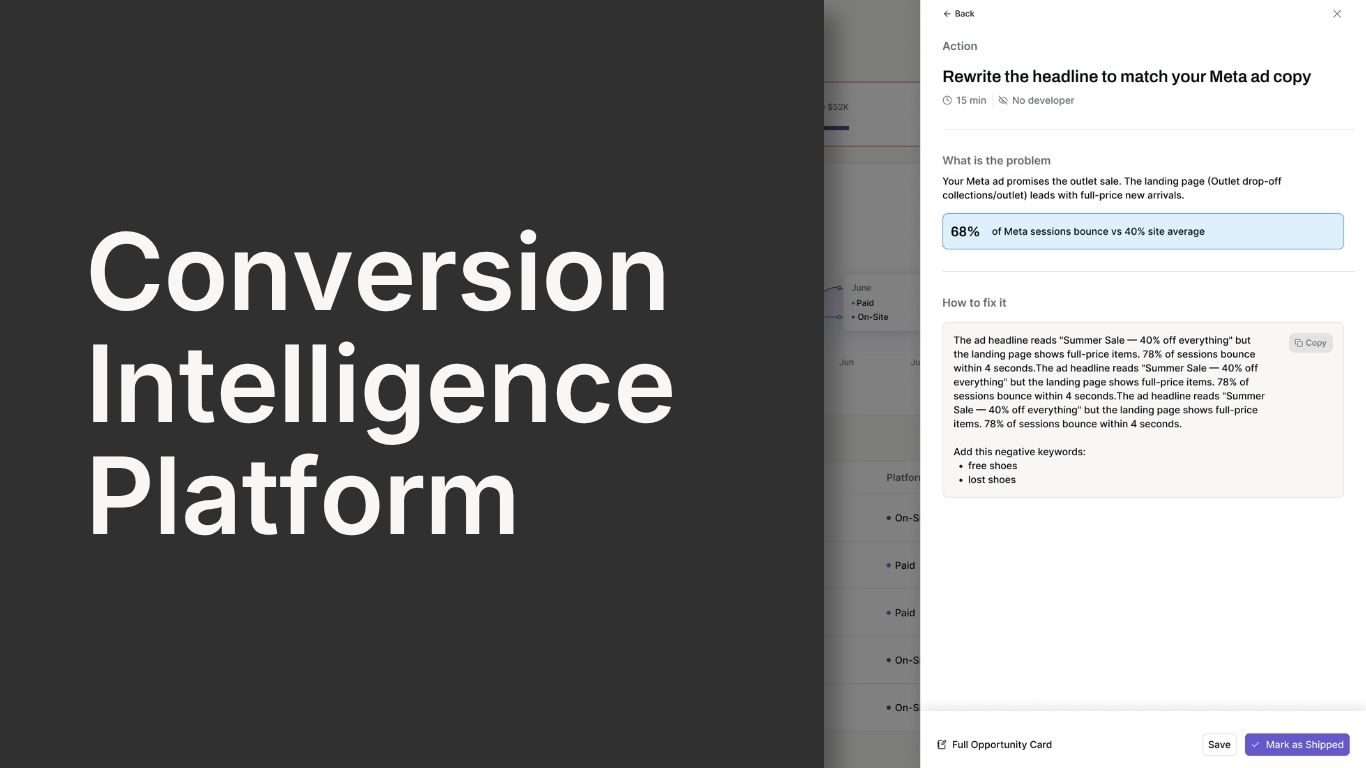
Between your analytics stack and an actual decision, there's a job no tool does.
The data every online brand collects can already answer the questions that matter: where the funnel breaks, what it costs, what to fix first. But the tools stop at description. Someone still has to dig through the numbers, work out why users are leaving, put a dollar figure on it, and argue the fix into a sprint. In most companies, nobody has that job. So the answers sit in the data, unasked.
That gap needed a name. We call it commerce intelligence, and this post is the definition: what it is, what it is not, and when you genuinely don't need it.
Key takeaways
- Commerce intelligence is a category, not a feature: software that detects friction, quantifies the revenue impact in dollars, and prescribes the fix, replacing the analyst-in-the-loop rather than assisting them.
- Analytics, session replay, and BI tools all stop at the same wall: they describe what happened and leave the "so what" and "now what" to a human who rarely has time to answer.
- Baymard's research pins average cart abandonment at 70.19%, and the leading causes are all fixable friction. The data to find these problems exists in nearly every online business. The diagnosis is what's missing. Source: Baymard Institute, https://baymard.com/lists/cart-abandonment-rate
- Below roughly 20,000 sessions a month, you don't need this category yet. Above it, the diagnosis gap starts costing real money.
The problem the category exists to solve
Every team selling online above a certain size runs the same loop, and the loop is broken in the same place.
Data comes in. GA4 shows a funnel. A heatmap tool shows where people clicked. A session replay tool records what they did. All of it is accurate. None of it is a decision.
So the data waits for a human. And the human has a day job. The head of ecommerce is running promotions. The marketer is feeding the paid channels. The developer is shipping the roadmap. The "look into the checkout drop-off" task sits in the backlog next to forty other observations, unpriced and unowned, until the quarterly review where someone says "we should really dig into that."
For years, the only ways to close that loop were expensive. Enterprise brands rented consultants whose actual day job was turning descriptions into diagnoses. Everyone else got dashboards. The tooling market's answer, for fifteen years, was more description: better funnels, prettier heatmaps, AI summaries of session replays. All of it still ends at the same wall, because description was never the bottleneck. Diagnosis was.
Some brands have started trying to close the loop with headcount, hiring roles whose entire brief is to sit between the data and the decision and say what the numbers mean. It's the right diagnosis of the problem. It's also a job description that reads, line for line, like a software specification.
What is commerce intelligence?
Commerce intelligence is software that detects friction across the commerce funnel, from ads to checkout, quantifies the revenue loss in dollars, and prescribes a specific fix, ranked by impact. Where analytics tools describe behaviour and leave interpretation to an analyst, a commerce intelligence platform does the diagnosis itself: it finds the problem, prices it, and hands you the decision.
Three parts make the definition, and all three are load-bearing.
Detection means the platform finds problems you didn't ask about. Not alerts on thresholds you configured, but anomalies surfaced from the funnel's own statistical behaviour. You don't run queries. The system runs them continuously and tells you when something is costing money.
Quantification in dollars is the part that changes organisational behaviour. "Checkout step two has a 34% drop rate" is an observation that survives months in a backlog. "This drop is costing $11,000 a week" is a business case that gets an owner by Friday. Same problem, different unit, completely different outcome.
Prescription closes the loop the analyst used to close. Not "investigate the payment step" but the specific fix with the reasoning behind it, grounded in how buyers actually make decisions: loss aversion when costs appear late, decision paralysis when too many options load at once, uncertainty aversion when delivery dates are vague.
Remove any of the three and you're back in an existing category. Detection without dollars is monitoring. Dollars without prescription is reporting with better units. Prescription without detection is a consultant.
What commerce intelligence is not
The fastest way to sharpen a definition is to draw its borders. Five adjacent categories get confused with it:
| Category | What it does | Where it stops |
|---|---|---|
| Web analytics (GA4, Shopify Analytics) | Measures traffic and events | Tells you what happened, not why or what it cost |
| Session replay and heatmaps (Hotjar, Contentsquare) | Shows individual behaviour | Someone has to watch, interpret, and generalise |
| Business intelligence (Looker, Power BI) | Aggregates data into dashboards | Assumes an analyst asks the right questions |
| A/B testing (Optimizely, VWO) | Validates a hypothesis | You need the hypothesis first |
None of these are bad tools. Most brands should keep several of them. The point is that they all share one assumption: a skilled human sits between the data and the decision, with the time and expertise to do the interpretation. In enterprise, that human sometimes exists. In the mid-market, almost never. The average online brand's team is an ecommerce lead, a marketer, and a developer, all with day jobs. The assumption fails, and the data sits there, describing.
Commerce intelligence removes the assumption instead of feeding it.
Is this just AI analytics with better marketing?
No, and the difference is where the AI sits. Bolting a language model onto a dashboard produces faster summaries of the same descriptions: plausible-sounding insights with no mathematical grounding, which is why teams stop trusting them within a month. Commerce intelligence inverts the order: statistical detection first, so every finding is mathematically real, then AI to translate the finding into a prescription.
This ordering matters more than it sounds. An LLM asked "what's wrong with my funnel" will generate something confident whether or not anything is wrong. A detection layer that flags only statistically significant anomalies, from the site's own behavioural baseline, and only then generates the explanation, produces fewer insights and keeps trust. Quantitative foundation, qualitative output. The rigour is the product.
It's also why "AI-powered analytics" and commerce intelligence tend to fail in opposite directions. The first fails by saying too much. The second is designed to say less, and be right.
When you don't need commerce intelligence
Honest borders on the other side too.
Below roughly 20,000 sessions a month, you don't have the statistical volume for detection to distinguish real friction from noise, and the dollar values on individual fixes won't justify the platform cost. At that stage, a heatmap tool plus common sense plus simple pricing math (sessions affected x conversion gap x average order value) covers most of what matters. Fix the obvious, grow the traffic, revisit later.
Same if you're mid-replatform (don't diagnose a site you're about to delete), or if you're a single-product store with a two-step funnel, where the whole journey is simple enough to reason about by hand.
And there's a class of problem no detection layer fixes: pricing, proposition, product-market fit. If buyers are leaving because the offer is wrong, the funnel data will show friction everywhere and nowhere. Software finds the leaks in a working proposition. It cannot make the proposition work.
Where the category goes next
Two expansions define the near future of commerce intelligence, and both follow from the same logic: the funnel doesn't start at your homepage, and soon it won't end with a human.
Upstream, paid media. Roughly half of most stores' funnel problems begin before the click: an ad promising something the page doesn't deliver, spend concentrating on traffic the site can't convert. Diagnosing why specific campaigns underperform requires joining ad-side and site-side data, which today lives in a spreadsheet nobody builds. We're expanding into this now, connecting ad spend to on-site behaviour so the diagnosis covers the full funnel.
Downstream, agentic commerce. As AI shopping agents start evaluating and buying on behalf of users, a new kind of friction appears: machine-side friction, where your product data is unreadable to the agent doing the shopping. Detection logic applies there too, and it's where we're heading next.
The direction across both is the same one that started the category: fewer dashboards, more diagnosis. Something that does the thinking and hands the human the decision.
Flowganise is a commerce intelligence platform: it detects friction across your funnel, from ads to checkout, quantifies the revenue loss in dollars, and prescribes the fix, ranked by impact. It's the analyst-in-the-loop, productised, at a fraction of what closing the loop used to cost. If you want to see what the diagnosis looks like on your own funnel, that's the fastest way to understand the category.